
Bridging Communities with Neighborhood Opportunity Hubs

Our team has collectively worked with community leaders to build growth plans, message change initiatives, and redevelop neighborhoods for cover forty years. Since 2014, we have specifically advanced the concept of Neighborhood Opportunity Hubs.
Distressed neighborhoods often experience a steady decline in household wealth, education levels, and individual health indicators. This is not just a local phenomenon but one that carries across much of the nation. Poverty, household income, and inequality as economic indicators have been moving in a negative direction for much of the past decade in a growing number of urban and rural neighborhoods.

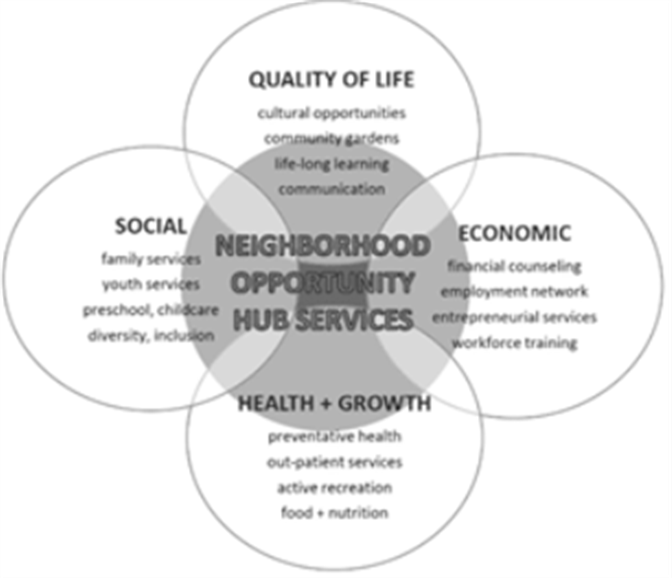
There is often a disconnect between the unmet needs of our more impoverished neighborhoods and the available opportunities to address them.
Access to important services and opportunities is difficult due to issues such as limited transportation and childcare options, lack of financial resources, and a general lack of confidence and sometimes trust in engaging with unfamiliar institutions or organizations. Too often, there are very real and personal roadblocks that prevent struggling households from taking advantage of the available opportunities.
Neighborhood Opportunity Hubs are intended to establish a convenient, visible, and inviting front door to a wide range of opportunities.
An Opportunity Hub may be integrated into an existing community center, education facility, or easily accessible public space.
It should first and foremost be a comfortable gathering place for residents of all ages. It may serve as a place for neighbors to socialize and recreate, as well as to access needed services and opportunities.
A critical element, in keeping with the 15-minute Complete Neighborhood concept, is a neighborhood-based resource that is easily accessible.
The types of measurable outcomes achieved by a Neighborhood Opportunity Hub are typically economic impact and workforce development-focused. Providing community services to remove barriers to workforce training and education for better-paying jobs is the integrative community solution that employers, the public, officials, and service providers alike are searching for.